



Affective Computing is a field that brings together artificial intelligence, computer science, psychology, and human–computer interaction to build systems capable of detecting some of the signals associated with emotional expression, and representing or responding to them. These systems may rely on the face, voice, text, or physiological signals, or on a combination of more than one channel.
Yet one fundamental correction has to come before any explanation:
The system has no direct access to the "true feeling" inside a person; it analyzes measurable signals and then infers from them probabilities or patterns associated with expression, state, and context.
This distinction is essential, because a facial expression, a tone of voice, or a quickening heartbeat does not necessarily equal one particular emotion; the same behavior may be linked to more than one state, and its interpretation shifts with the person, the culture, and the situation. That is why modern affective computing has moved away from the idea of absolute "emotion reading" and toward measuring expression, context, arousal, and behavioral patterns, while always acknowledging a margin of uncertainty.
Where Did the Concept of Affective Computing Come From?
The founding of the modern field is closely tied to the work of Rosalind W. Picard at the MIT Media Lab. In a 1995 technical report titled Affective Computing, Picard defined the field as computing that relates to, arises from, or deliberately influences emotion, and discussed the recognition of emotional expression and its applications in learning, health, and human–computer interaction. The idea was then expanded in her book Affective Computing, which became one of the field's foundational references.
The original idea was not that the computer would necessarily become "a human who feels," but that ignoring the emotional dimension leaves human–machine interaction incomplete in many situations, especially when social signals and context are decisive.
Affective Computing and Emotion Recognition: The General and the Specific
The two terms are often used as synonyms, but they are not. Emotion Recognition is a subset of the tasks that fall within Affective Computing. Affective computing is far broader: it covers measuring expression, modeling affective state, detecting behavioral changes, designing interfaces that respond to user signals, generating expressive voice or behavior, supporting human–machine interaction research, and building multimodal systems. An Emotion Recognition system, by contrast, usually tries to classify or estimate an emotional state from specific data.
This distinction has gained legal weight in recent legislation; the European Union's AI Act defines an "emotion recognition system" as an AI system intended to identify or infer people's emotions or intentions on the basis of their biometric data.
The Limits of Inference: Expression Is Not Feeling
Can AI Really Know What a Person Feels?
Not with certainty from a single signal. This is one of the most important scientific and ethical points in the entire field. For a long time, the assumption prevailed that certain facial expressions map directly onto specific emotions: a smile means happiness, a frown means anger, and so on.
But broad scientific reviews have revealed that the relationship between facial movements and emotional state is far more complex. A well-known review in Psychological Science in the Public Interest concluded that inferring emotions from facial movements alone faces major limitations, and that context, culture, and the individual play important roles. A 2024 study in Nature Communications showed that contextual information can, in some cases, be more informative than the isolated face when inferring emotional state.
That is why some modern platforms adopt more cautious language. Hume AI, for example, distinguishes between Expression Measurement and the claim to know what a person feels internally; that is, the system measures expression patterns that humans associate with certain emotions, and does not present itself as a "mind reader."
One Signal, Many Interpretations
The difference between emotional expression and internal state becomes clear when we consider two familiar signals:
| Signal | Possible Interpretations |
|---|---|
| A smile | Happiness, nervousness, politeness, sarcasm, hiding annoyance, responding to social norms |
| A raised heart rate | Fear, excitement, exercise, caffeine, pain, illness, stress |
The same signal lends itself to more than one reading, which is why the outputs of Affective AI are best treated as probabilities or indicators, not definitive psychological diagnoses.
How Do Systems Represent Emotions?
Before a system analyzes any signal, it needs a model with which to describe what it is trying to estimate. There is no single theory agreed upon for all uses, but rather main approaches, each with its strengths and limits.
Discrete Models
These models classify states into categories such as joy, sadness, anger, fear, disgust, and surprise. They are convenient for building classification models, but may oversimplify human experience. Moreover, treating a small set of expressions as "universal and fixed" is not a simple scientific fact; there is extensive debate about the influence of context, culture, and the nature of the situation.
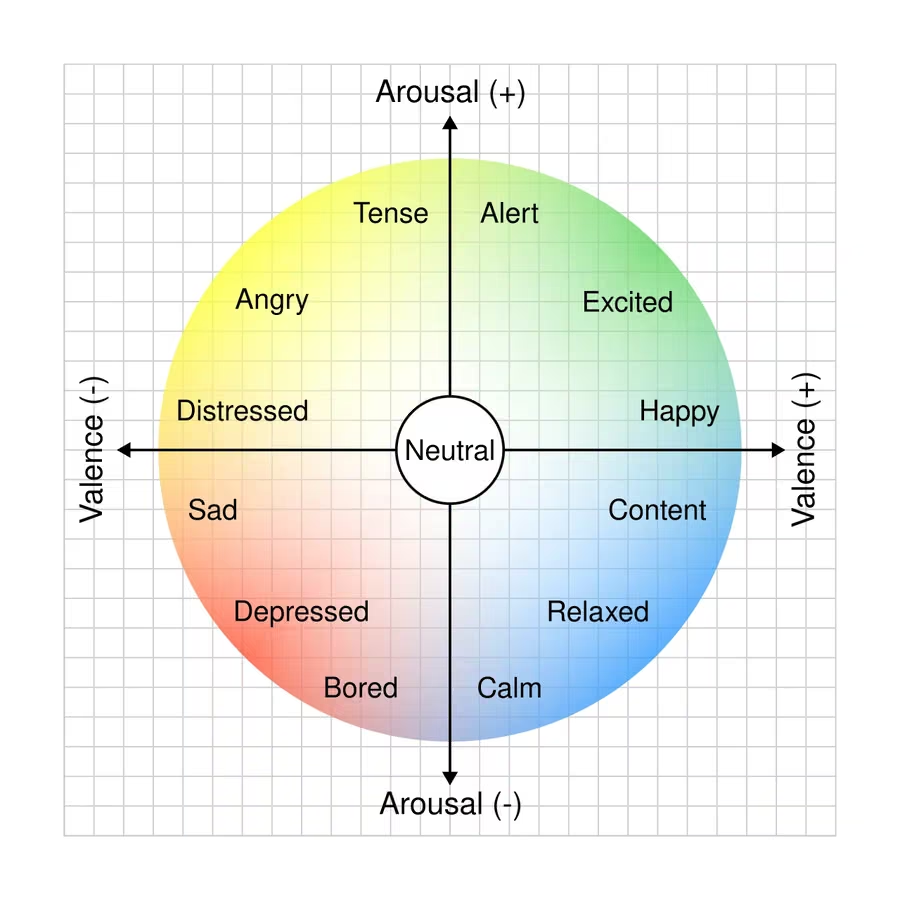
Dimensional Models
Instead of placing each state in a separate box, these models represent emotions along continuous dimensions, the best known being Valence, which measures whether the experience is positive or negative, and Arousal, which measures the level of activation or energy. Some models add a third dimension such as Dominance, but it is not an inherent part of every two-dimensional model. The advantage of this approach is that it allows mixed or graded states to be represented, rather than forcing the system to pick a single category.
FACS: Describing Movement, Not Naming Feeling
The Facial Action Coding System (FACS) breaks down facial muscle movements into units called Action Units, recording, for example, a movement of the eyebrow, the mouth, or the area around the eye. But FACS at its core describes facial movement; it does not mean a particular Action Unit alone reveals a fixed internal emotion.
The importance of this point lies in the fact that some applications leap straight from "detecting a facial movement" to "knowing what the person feels," a leap that does not hold without a model, context, and additional evidence.
How Do Affective Computing Systems Work?
These systems generally pass through five successive stages: they begin by capturing data, then clean and represent it, extract features from it, pass them to an AI model, and end with outputs in the form of probabilities or a response. The details of each stage vary with the data source, which we follow channel by channel.
The Face: Analyzing Expressions from Images and Video
Facial Expression Analysis uses images or video to extract patterns from the face. The pipeline usually involves detecting the face, aligning the image, extracting Facial Landmarks or features, and passing them to a CNN, a Vision Transformer, or a specialized model, which finally produces scores or categories associated with the expression. Modern models can capture far more complex patterns than the old handcrafted methods could.
But the challenges are real: camera angle, lighting, glasses and masks, differences in face shape, age, culture, the difference between posed and spontaneous expression, and social context. So a model's accuracy on a lab dataset should not be taken as evidence that it can read a person's psychological state in any real-world environment.
For a practical application showing how facial-expression computer vision is combined with recommendation engines and what its scientific limits are, see our specialized study: Facial Expression Analysis via Camera and Content Personalization: How Do Emotion-Aware Recommendation Systems Work?.
The Voice: How Something Is Said, Not Just the Words
Speech Emotion Recognition and Vocal Expression Analysis focus on how speech is delivered, not only on the words. The system may analyze pitch, loudness, rhythm, speaking rate, pauses, and voice quality, along with representations such as the spectrogram, MFCCs, or learned audio representations.
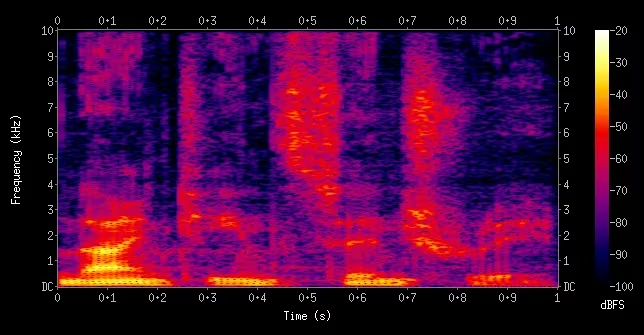
Modern systems rely on CNNs, RNNs/LSTMs, Transformers, and speech pretraining models. Even so, the voice does not directly reveal the "true state" either; a person may speak calmly while angry, raise their voice because of a noisy environment, or sound different because of illness, accent, or age. This is precisely what modern Voice AI research acknowledges: vocal expression and internal emotion are not the same thing.
Text: Beyond Sentiment Analysis
In text, systems use NLP techniques and large language models (LLMs) to analyze overall sentiment, emotion labels, stance, intent, writing style, and certain linguistic markers. But Sentiment Analysis is not the same as affective computing as a whole. A sentence like "The service is excellent but the price is annoying" is positive toward quality and negative toward price at the same time, which is why techniques such as Aspect-Based Sentiment Analysis emerged.
Text analysis still faces well-known obstacles: sarcasm, dialects, figurative language, context, words with multiple meanings, cultural differences, and very short texts.
Physiological Signals: A Different Channel, Not a Lie Detector
Physiological signals may seem more honest than the face and voice, but in truth they are different, not more truthful. Signals in use include ECG, HRV, PPG, EDA/GSR, and EEG, along with respiration and skin temperature. Their value lies in the fact that some physiological responses correlate with the degree of arousal, stress, or neural activity, but they are not a direct map of every emotion.
Take EDA, for instance: it may be sensitive to changes in arousal, but on its own it cannot tell us whether a person is frightened or excited.
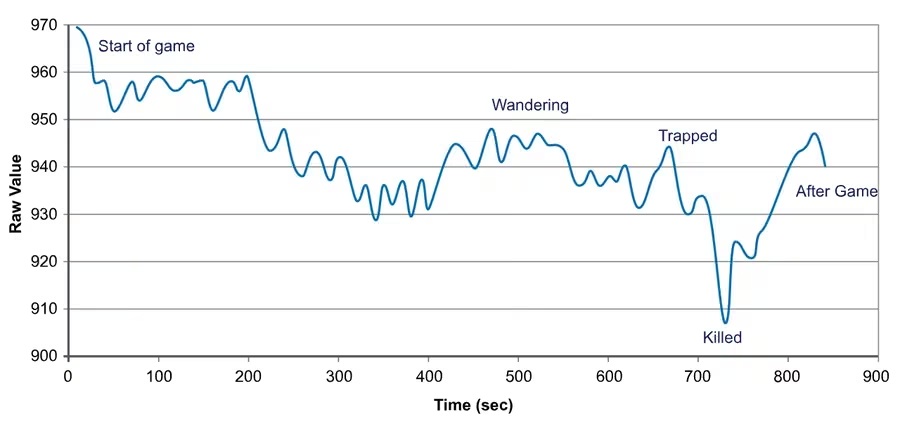
The same goes for HRV, which may change because of psychological stress, but is also affected by physical activity, breathing, age, medication, and health status. Physiological signals are a powerful channel, especially when combined with context and other data, but they do not give the system direct access to "emotional truth."
Multimodal Fusion
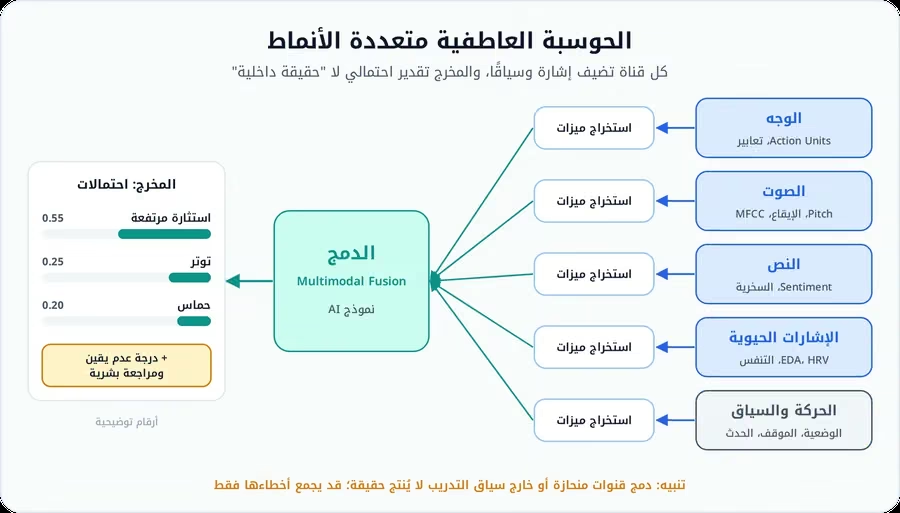
Multimodal Affective Computing combines more than one channel: face, voice, text, movement, and physiological signals. The logic is that a single channel may be ambiguous, while other channels add context that resolves the ambiguity; if the text is sarcastic, tone may help interpret it, and if the face is partly hidden, voice or context may fill the gap.
But fusion does not automatically turn an inference into fact. If each channel is biased, inaccurate, or outside its training context, the system may end up combining several unreliable signals instead of solving the problem.
Where Is Affective Computing Used?
The value and risks of these technologies differ greatly from one field to another, so each field deserves its own reading.
Human–Machine Interaction
One of the most sensible uses is designing interfaces that respond to expression and interaction signals rather than relying solely on explicit commands. A voice assistant might detect hesitation or frustration in a user's voice and then slow its explanation, change its response style, ask for clarification, or hand the user over to human support. Hume AI currently offers tools for measuring vocal expression patterns such as rhythm, energy, and pitch, along with a large set of expression dimensions, while stressing that it measures expression, not a certain internal state.
Driver Monitoring and Safety
In-vehicle systems can analyze gaze direction, eye closure, yawning, head pose, distraction, and some expressions or voice characteristics. Companies such as Smart Eye provide Driver Monitoring systems based on Computer Vision, with additional capabilities related to expression analysis.
But two things must be distinguished here: detecting drowsiness or fatigue, a physical and behavioral state tied to safety, and inferring emotions such as anger or sadness. Even the European AI Act draws a legal distinction between them, excluding fatigue detection for safety purposes from the definition of Emotion Recognition in this context.
Health and Clinical Research
Digital Phenotyping research uses data from phones and wearables to study how digital behavior correlates with physical and mental health, and may include movement, sleep, activity, phone interaction, voice, questionnaires, and some physiological indicators. These are promising areas for monitoring and research, but recent studies stress that the evidence remains heterogeneous, and that differences in devices, data, and study designs make generalization and translation into clinical use a matter requiring caution. These systems should therefore be treated as research or decision-support tools when validated, not as an automatic substitute for medical or psychological assessment.
Education
In education, indicators such as engagement, hesitation, time on task, help requests, navigation within content, and interface behavior can be tracked and used to adjust content or offer hints. But there is a clear red line:
In the European Union, the AI Act prohibits the use of AI systems that infer people's emotions from their biometric data in workplaces and educational institutions, except for specific uses for medical or safety reasons.
This means that turning on a student's camera to infer "boredom" or "frustration" inside an educational institution is not merely a question of accuracy and privacy; it may fall within a legally prohibited use inside the EU. Behavioral Analytics that do not infer emotions from biometric data are a different matter, requiring a separate privacy and legal assessment.
Learning Support and Special Needs
There are educational apps that help children, including some children with autism spectrum disorder, learn to recognize facial expressions or use alternative communication tools. But one should be careful not to label every app of this kind "Emotion AI." Otsimo, for example, offers games, special education, and speech and communication training, and includes activities for learning to distinguish emotions and expressions, but it is not in itself evidence of a system that infers a child's internal emotional state from their voice.
Affective Computing and Artificial Empathy
A model may generate a response that sounds empathetic, such as: "It sounds like this situation has been exhausting. Would you like to go through the options step by step?" But that does not mean the system feels empathy the way a human does. It is more accurate to call this behavior an Empathic response, Empathy simulation, or Emotionally adaptive interaction; the claim that the system has an internal affective experience is an entirely different matter that response quality cannot prove.
This distinction matters especially in mental-health and conversational systems, because users may attribute to the system psychological capacities or a personal relationship that go beyond what it actually possesses.
The Risks of Affective Computing
Confusing Expression with True Emotion
The biggest mistake is turning a signal into definitive truth: a frown does not always mean anger, a smile does not always mean happiness, and a raised heart rate does not always mean fear. This mistake is compounded by missing context, which can matter more than the signal itself; the same sentence, glance, or tone carries different meanings in different situations.
Cultural and Individual Differences, and Bias
Culture shapes how people express themselves, how much emotion they show, how faces and voices are interpreted, and the social rules governing all of this, and recent studies show that describing and interpreting facial expressions is influenced by culture. Closely tied to this is the risk of bias: if a dataset represents one population group more than others, performance may drop for other cultures and ages, for people with disabilities, for different dialects, and for under-represented expression patterns.
Privacy
Affective computing data is not ordinary data; it may include the face, voice, behavior, heart rate, skin conductance, usage patterns, and even health or quasi-health data. Fundamental questions therefore arise: Does the person know what is being collected about them? Why is it collected? Can it be reused? Who owns the data? When is it deleted? Could the result influence a decision about them?
Emotional Manipulation
If the system knows the user is hesitant, afraid, or excited, that information may be used to improve assistance, but it may also be used to time an ad, push a purchase decision, or influence behavior at a moment of vulnerability. So model accuracy is not enough; the purpose of use itself must be assessed.
High-Stakes Decisions
An unreliable emotional estimate should not be used as a sole decisive factor in hiring, sanctions, medical diagnosis, student assessment, credit, investigations, or predicting criminal behavior. The higher the stakes of the decision, the higher the required level of evidence, transparency, and human oversight.
What Does the European AI Act Say About Emotion AI?
By 2026, the legal dimension had become an essential part of any serious discussion of Affective Computing. The EU AI Act defines an emotion recognition system as an AI system intended to identify or infer people's emotions or intentions on the basis of their biometric data, and prohibits the use of such systems in workplaces and educational institutions, with specific exceptions when the use is for medical or safety reasons.
In permitted uses to which its provisions apply, the Act also imposes an obligation to inform people exposed to an Emotion Recognition system of its presence and operation, in line with relevant data protection laws. This is a clear example of the issue moving from theoretical ethical debate to actual legal requirements.
How Should an Affective Computing System Be Evaluated Before Use?
The usual question, "How accurate is it?", is not enough on its own. A serious evaluation goes through six broader questions:
| Question | What to Check |
|---|---|
| What does it actually measure? | Facial movement, tone of voice, physiological arousal, sentiment, engagement, or an emotion label? |
| What is the ground truth? | Was truth established during training through self-report, observer labeling, acted portrayals, clinical diagnosis, or a lab task? |
| Has it been tested outside the lab? | Performance with a phone camera, poor lighting, a multicultural environment, noise, illness, and long daily use |
| Are there results across different groups? | Sex, age, language, culture, skin tone, disability, different devices |
| What does an error cost? | An error in adjusting an interface color is not like an error in a diagnosis, hiring, student assessment, or a security decision |
| Does the system need to infer emotions at all? | Sometimes direct behavioral signals are better and less intrusive |
The last question is often overlooked even though it may be the most important: if we want to know whether a student watched a video to the end, ordinary analytics may be far more suitable than a camera trying to infer "boredom."
What Is the Future of Affective Computing?
The field's strongest future does not necessarily lie in "a machine that reads emotions with absolute accuracy." The more realistic direction is building systems that are multimodal, context-aware, and more personalized; candid about uncertainty; and better at measuring expression than at claiming to read minds. Systems that run locally or in privacy-preserving ways where appropriate, are tested across multiple cultures, dialects, and environments, keep a Human-in-the-loop for sensitive decisions, separate physical states from expression and psychological state, and draw clear lines between assistance and manipulation.
Meanwhile, Voice AI is evolving quickly toward measuring more detailed expression dimensions instead of confining people to just six emotional categories. In health, Digital Phenotyping is advancing, but recent studies still call for more standardization and external validation before broad adoption in clinical practice.
Conclusion
Affective computing is one of the most fascinating intersections of artificial intelligence and the human sciences, because it deals with a part of interaction that computers long ignored: expression and emotional context. Systems can analyze the face, voice, text, and physiological signals, and AI can detect patterns that humans cannot monitor manually at scale.
But the ability to measure a signal does not mean knowing the inner feeling with certainty, and this is the dividing line between good and misleading use of the technology. The field's future will depend not only on more accurate models, but on a clear definition of what is measured, better context, more representative data, realistic testing, respect for privacy, regulation of high-risk uses, and keeping humans at the center of decisions when the outcome is sensitive.
Sources and References
Rosalind W. Picard, Affective Computing, MIT Media Laboratory Technical Report No. 321 (1995)
https://vismod.media.mit.edu/tech-reports/TR-321.pdfMIT Press — Affective Computing, Rosalind W. Picard
https://mitpress.mit.edu/9780262661157/affective-computing/Barrett et al. (2019), Emotional Expressions Reconsidered: Challenges to Inferring Emotion From Human Facial Movements
https://journals.sagepub.com/doi/full/10.1177/1529100619832930Goel et al. (2024), Face and context integration in emotion inference is limited and variable across categories and individuals, Nature Communications
https://www.nature.com/articles/s41467-024-46670-5Wnuk & Wodowski (2024), Culture shapes how we describe facial expressions, Scientific Reports
https://www.nature.com/articles/s41598-024-72432-wFrontiers in Digital Health (2025), Emotionally adaptive support: a narrative review of affective computing for mental health
https://www.frontiersin.org/journals/digital-health/articles/10.3389/fdgth.2025.1657031/fullDigital phenotyping for mental health conditions: a systematic review of implementation and application (2026)
https://pmc.ncbi.nlm.nih.gov/articles/PMC13391508/Regulation (EU) 2024/1689 — Artificial Intelligence Act
https://eur-lex.europa.eu/eli/reg/2024/1689/2026-07-27/engHume AI — Expression Measurement API
https://www.hume.ai/expression-measurement-apiHume AI — Can AI "detect" emotions?
https://www.hume.ai/blog/can-ai-detect-emotionsSmart Eye — Driver Monitoring System
https://smarteye.se/solutions/automotive/driver-monitoring-system/Otsimo — Special Education and Speech Therapy
https://otsimo.com/en/Otsimo — Learn Feelings
https://otsimo.com/en/game/learn-emotions/
Frequently Asked Questions
What is affective computing?
Affective computing is a field that studies building systems capable of detecting, representing, and responding to signals related to emotion and expression, using data such as face, voice, text, and physiological signals.
Can AI read emotions from the face?
It can classify patterns in facial expressions, but the face alone cannot be treated as a definitive reading of the inner emotional state. Context, culture, and individual differences all influence the interpretation.
What is the difference between sentiment analysis and affective computing?
Sentiment analysis usually focuses on the stance or attitude expressed in text, while affective computing is broader and covers face, voice, behavior, physiological signals, and adaptive interaction.
Do physiological signals detect emotions more accurately?
They provide useful information about arousal and physiological state, but they are not a direct measure of a specific emotion. They must be interpreted alongside context and other variables.
What is affective computing used for in cars?
Cabin systems can use computer vision and audio to monitor distraction, fatigue, and some expression patterns. A distinction should be made between drowsiness detection for safety purposes and inferring emotions.
Is affective computing used in education?
There is research and there are platforms measuring engagement and behavior, but inferring emotions from biometric data in educational institutions is prohibited in the EU under the AI Act, with narrow exceptions for medical or safety uses.
Is affective computing suitable for mental health?
It is a promising research area for monitoring and digital phenotyping, but clinical evidence is still mixed, and such systems should not replace professional assessment without proper validation and certification.
Can AI be empathetic?
It can generate a response that appears empathetic and adapts to expression and context, but that does not prove it experiences empathy as an inner human experience.
How does the system analyze emotional expression from a speaker's voice?
Speech analysis focuses on how something is said rather than the words alone, extracting features such as pitch, intensity, rhythm, speaking rate, pauses, spectrograms, and MFCCs, then feeding them to models such as CNNs, LSTMs, or Transformers. However, the voice does not directly reveal the true state: a person may speak calmly while angry, or their voice may change due to illness, accent, or noise.
What is the difference between categorical and dimensional emotion representation?
Categorical models classify the state into classes such as happiness, sadness, anger, and fear; they make it easy to build classification models but can oversimplify the human experience. Dimensional models represent emotions on continuous dimensions — most commonly valence for how positive the experience is and arousal for the level of activation — allowing mixed or graded states instead of forcing a single category.
Technical Discussion (0)
Sign in to join the discussion, reply and like comments.


