



A camera can be used to analyze movement and expression patterns in the face, then convert them into probabilistic estimates that are added to recommendation systems as a contextual signal that helps personalize content. But it is essential to distinguish between facial expression analysis and knowing true inner feelings; an image does not give the system direct access to what a person feels.
This distinction is the foundation on which any system combining computer vision, Affective Computing, and recommendation systems must be built. The system may detect a pattern resembling expressions labeled in the training data as "happiness," "sadness," or "surprise," but what it actually produces is a probabilistic estimate based on data and a model, not a final diagnosis of a psychological state. That estimate can then be used alongside other information, such as usage history, user preferences, and current context, to choose more suitable content.
The Core Idea of the System
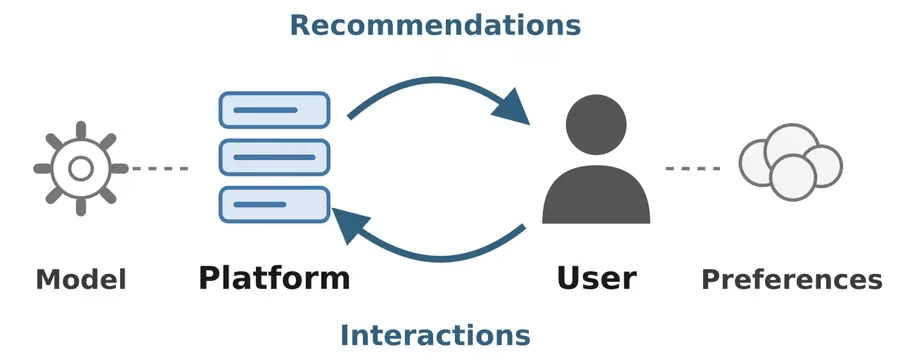
The chain starts with the camera, then face detection and expression analysis, producing a probabilistic estimate that is merged with the user's context and passed to the recommendation engine, which suggests content, while the user's interactions with it return as feedback that improves the next round.
The system might, for example, capture facial patterns to which the model assigns the following scores:
| Expression Class | Score |
|---|---|
| Neutral | 0.46 |
| Sad-like expression | 0.27 |
| Happy-like expression | 0.15 |
| Other expressions | 0.12 |
The common mistake here is turning the result directly into a rule like "The user is sad, so show them happy music." A more mature recommendation engine treats it as one signal among many, reading it as: "An expressive pattern leaning toward class X appeared with limited confidence, the user's history indicates preference Y, and the current context is Z," and then ranks candidate items based on all of this data. This approach is far closer to reality than a system that maps each expression to fixed content.
Can a Camera Detect "Inner Feelings"?
The face alone cannot be considered a reliable window into one's inner emotional state. This point matters because a large share of historical Facial Emotion Recognition systems were trained on images or videos carrying labels such as Happy, Sad, Angry, Fear, Disgust, Surprise, and Neutral. But the presence of these labels in a dataset does not mean every smile in the real world equals "happiness" with certainty.
A broad scientific review published in 2019 in Psychological Science in the Public Interest concluded that the relationship between facial movement patterns and emotions is more varied and more dependent on context and culture than the simplified view, which links each expression to a single emotion, assumes. A 2024 study in Nature Communications also showed that information drawn from the situation and context can be equal to, and sometimes better than, the isolated face when inferring emotional states.
That is why this article uses phrases such as "facial expression analysis," "estimating an expression class," and "probabilistic emotional inference," instead of claiming that the camera "reads inner feelings."
Face Recognition and Expression Analysis: Two Different Tasks
Two entirely distinct tasks are often confused:
| Task | The Question It Answers | Relation to Identity |
|---|---|---|
| Face Recognition | Who is this person? | Relies on matching the face's identity |
| Facial Expression Recognition or Analysis | What movement or expression pattern appears on the face? | Does not necessarily need to know the person's identity |
A system can analyze a facial expression without trying to determine who the person is. This separation matters from both a design and a privacy perspective: if the system does not need to know identity, Facial Identification should not be added unnecessarily.
How Does the Face Analysis Stage Work?
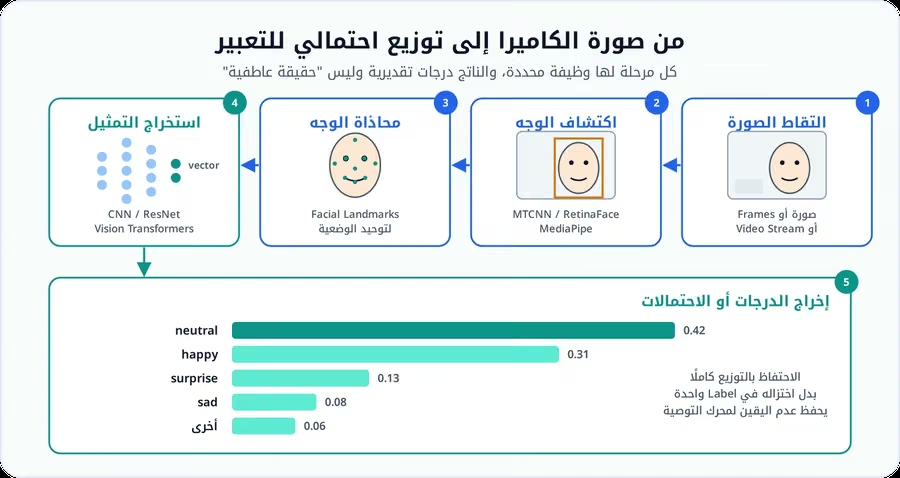
Capturing the Image or Video
The camera provides a single image, a sequence of frames, or a continuous video stream. Video may carry temporal information that does not appear in a still image, such as how quickly an expression changes.
Face Detection
The system locates the face within the scene, using models and techniques such as MTCNN, RetinaFace, MediaPipe-based pipelines, and modern detection models. This stage does not determine emotion; its job is only to locate the face region.
Face Alignment
The face may be tilted, distant, close, or turned away. So Facial Landmarks are used to estimate the positions of the eyes, nose, mouth corners, and face outline, and this information is then used to align and standardize the image before analysis.
Extracting the Visual Representation
Traditional methods relied on features such as Local Binary Patterns (LBP), Gabor filters, and facial landmark geometry. Modern models rely more on deep learning, through CNNs, ResNet-like backbones, Vision Transformers, and hybrid CNN/Transformer architectures. Instead of an engineer defining each feature by hand, the model learns its representations from the training data.
Outputting Scores or Probabilities
Finally, the model produces scores tied to the classes it was trained on, and it is better to keep the full probability distribution rather than collapsing it immediately into a single label, for instance an output like [neutral: 0.42, happy: 0.31, surprise: 0.13, sad: 0.08, ...]. This preserves part of the uncertainty that the recommendation engine will need later.
FACS: Does Facial Movement Turn into Emotion?
The Facial Action Coding System (FACS) is a system developed by Paul Ekman and Wallace Friesen to describe facial movements methodically, dividing them into units called Action Units (AUs); AU12, for example, is associated with raising the corners of the mouth, and AU4 describes a specific eyebrow movement.
But FACS describes facial movement and nothing more. Moving from "we detected a certain AU" to "so this person feels emotion X" is an additional inference step, not an automatic property of FACS. Action Units can therefore be useful as features, but they must not be treated as conclusive psychological evidence.
Datasets: What the Model Learns Is Shaped by What It Has Seen
Datasets play a decisive role in shaping a system's performance and limits, and each has a character that leaves its mark on the model.
FER2013
FER2013 was created as part of a challenge at ICML in 2013 and contains 35,887 face images, converted to grayscale at 48×48 resolution and classified into seven broad categories. It is historically important, but its images were collected from the web using emotion-related search terms, which means the labels and the collection method themselves influence what the model learns.
CK+
The Extended Cohn-Kanade dataset, or CK+, is more controlled, lab-style data, containing 593 video sequences from 123 people, usually starting from a neutral state and ending at the peak of a deliberate expression, with 327 of these sequences carrying expression-class labels. This makes it useful for research, but it does not fully resemble the natural everyday environment, where lighting, contexts, and expressions keep shifting.
AffectNet
AffectNet was designed for more realistic settings: the project collected more than one million face images from the internet, and a large portion were labeled by humans with expression categories and Valence/Arousal measurements. Its advantage is greater diversity than lab datasets, but real-world data in turn carries noise, ambiguity, and class imbalance.
RAF-DB
RAF-DB contains 29,672 real-world images collected for expression recognition in natural conditions, with crowdsourced labeling covering both basic and compound categories. RAF-DB's own research shows that real-world expressions are more varied than the stereotypical expressions found in lab datasets.
Why Isn't a Single Dataset's Accuracy Enough?
Because the question is not limited to "How did the model score on the test split?" but extends to others: Does the test data resemble the real environment? Do the faces represent all users? Are the images posed or spontaneous? Are the lighting and camera similar? How were the labels assigned? Are the classes balanced? And does the model work across other cultures and environments? That is why cross-dataset and real-world validation must be performed before relying on the system.
From the Face Result to a Content Recommendation
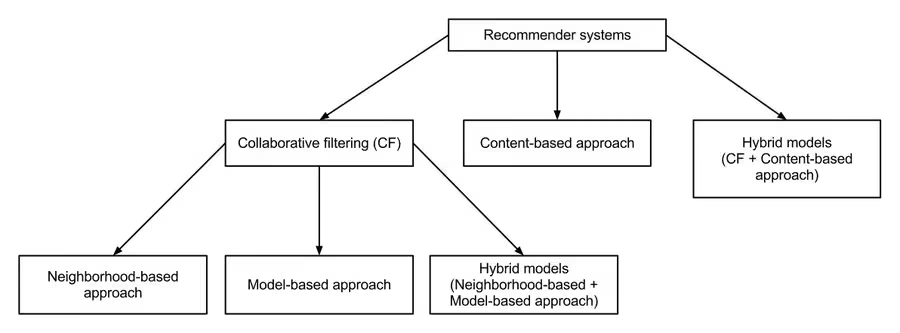
Here we move from computer vision to recommendation systems, which traditionally rely on three approaches.
Content-Based Filtering
It suggests items similar to what the user preferred before; if they read several articles about artificial intelligence, similar articles can be suggested.
Collaborative Filtering
It relies on the patterns of other users: users who liked A and B also liked C, so you might like C.
Hybrid Recommendation
It merges more than one source. In a context-aware system, the estimated expression can be added to other factors such as usage history, time, device, general location where its use is legitimate and permitted, session behavior, the current goal, and explicit feedback. The emotional signal thus becomes an additional feature inside the model, not the sole source of the decision.
Fixed Rules or a Learned Recommendation Model?
The Problems of a Rule-Based System
A simple version can be built with rules: a sad-like expression leads to uplifting content, a happy-like expression leads to energetic content, and neutrality sends the system back to historical preferences. But this design suffers from clear problems: it assumes everyone wants to adjust their mood the same way, it does not know whether the user wants mood congruence or mood repair, it overtrusts the face classification, it repeats the same content, and it ignores the user's history.
Five Separate Stages
It is usually better to separate the stages from one another:
| Stage | What It Does |
|---|---|
| Expression Estimation | Produces a probability distribution of the expression |
| Context Layer | Adds user history, session data, explicit preferences, and current context |
| Candidate Generation | Generates a set of candidate content |
| Ranking | Ranks items based on a multi-factor score |
| Feedback | The system learns from clicks, skips, likes and dislikes, watch time, explicit mood feedback, and dismissing the recommendation |
The conceptual ranking formula might take the form Score = Preference + Context + ExpressionSignal + ItemQuality + Diversity - Risk, though it should not be treated as a universal equation but as an example of a way of thinking. The feedback stage, meanwhile, is more reliable than re-analyzing the face continuously without need.
Does the Current Expression Actually Improve Recommendations?
Some research shows that incorporating emotional or affective information can improve certain recommendation systems in specific domains. A study in Expert Systems with Applications developed an affective music recommendation model and found, within its experimental setup, that incorporating an Affective Profile improved recommendation accuracy compared with some baselines that do not use emotional information.
But this result has limits that must be understood: it does not mean any camera will raise recommendation accuracy, nor that facial expression is the best way to obtain affective state, and self-report or session behavior may be cheaper and more accurate in certain cases. So the practical question should be:
Does adding this signal improve the system for this audience and this task enough to justify its cost and risks?
Mood Congruence or Mood Repair?
When designing content mapping, two common directions emerge. The first is Mood Congruence, suggesting content that matches the current state, such as calm music when signals point to a calm state. The second is Mood Repair or Regulation, suggesting content aimed at changing the state, such as soothing content when there are indicators of stress.
But the system should not automatically decide what the user ought to feel. It is better for the user to set their own goal, asking for example "Suggest something that matches my mood" or "I want something to help me relax." This turns the mapping from an implicit psychological attempt into an explicit preference the user controls.
Why Explicit Feedback Matters
If the goal is to know the user's mood, a simple question like "How's your mood today?" may be clearer, less intrusive, cheaper, and more privacy-respecting than a camera watching their face.
A graduated hybrid approach can be designed: it starts with an optional mood choice, then usage data, then the camera expression signal only when the user agrees and there is a genuine reason, with the ability to disable the feature at any time. This approach is consistent with the principle of Data Minimization: do not collect sensitive data if the goal can be achieved in a simpler way.
The Main Technical Problems
Facial expression analysis has many sources of error, collected in the table below:
| Problem | Its Effect |
|---|---|
| Lighting | Poor lighting or shadows can change the features the model sees |
| Head angle | Turning the face can hide important parts |
| Occlusion | Glasses, a mask, a hand on the face, or hair can cover parts of it |
| Camera quality | Resolution, frame rate, and compression affect the available signal |
| Domain Shift | A model trained on internet images may behave differently on a webcam or phone, or in a car, school, or hospital |
| Individual and cultural differences | Expression is not uniform across all people |
| Label Uncertainty | A training image's label may come from annotators, a posed expression, a search term, self-report, or context, and each method has its limits |
| Class Imbalance | Some expressions appear in the dataset far more often than others |
The Risks of Bias
When training data does not represent all groups well, error rates may differ by skin tone, age, sex, culture, face shape, disability, and imaging conditions.
It is important not to use the Gender Shades study as if it were direct proof of bias in Emotion Recognition; it studied Commercial Gender Classification, not emotions. But it remains an important example of how face analysis systems can deliver demographically unequal performance, which is why every emotion-aware system needs a bias audit specific to its task and data.
The Risks to Privacy
Using a camera to personalize content raises questions that a traditional recommendation system does not: Does the system need to send video to the cloud? Are images stored? Are Face Embeddings retained? Are they linked to the user's account? Are they used to train another model? Can the user delete their data? Is the feature on by default or opt-in? And can the result be used for advertising?
The best design from a privacy standpoint may be for the camera to capture a frame, process it on the device itself, produce expression probabilities, and then delete the raw frame immediately, so that video never leaves the device at all, if the architecture and goal allow it. But edge processing does not solve every ethical problem; we still have to justify why the signal is collected and used.
What Does the European AI Act Say?
This is a pivotal aspect for any project deployed or used in the European Union. The EU AI Act defines an Emotion Recognition system as an AI system intended to identify or infer people's emotions or intentions on the basis of their biometric data, and prohibits the use of AI systems to infer people's emotions in workplaces and educational institutions, except for specific uses for medical or safety reasons.
So the scenario "a classroom camera reads a student's frustration and changes the content" may not be merely a technical feature requiring consent; it may fall within a prohibited use in the European Union if it relies on biometric data to infer emotions and the exception does not apply. Article 50 also stipulates that, in permitted uses, deployers of Emotion Recognition systems must inform the people exposed to the system of its operation, while applying the relevant data protection rules. This makes privacy and legal review part of the architecture, not a step added after the product is finished.
Usage Contexts: Where It Fits and Where It Does Not
Mental Health
It is inappropriate to build logic of the form: the face looks sad, so the user is depressed, so offer them treatment. A facial expression is not a diagnosis. If the project enters the domains of mental disorders, suicide risk, diagnosis, treatment, or health recommendations, we move into a high-risk scope that needs clinical validation, specialists, strict governance, human oversight, and legal and regulatory assessment. Affective signals can be used in research or to support the experience, but they should not be presented as a direct substitute for a professional.
Education
Technically, there is historical research on Affective Tutoring and systems that respond to frustration or confusion, but real-world application today requires separating two kinds of adaptation. The first is Behavioral adaptation, built on signals such as a student repeating a question three times, making repeated mistakes, pausing for a long time, or requesting a hint; these are signals that can be used to adjust content without inferring emotion from the face. The second is Biometric emotion inference, such as analyzing a student's face with a camera to infer boredom or frustration, a use prohibited in educational institutions within the European Union, except for specific medical or safety cases. This reveals an important principle:
Sometimes the adaptation we want can be obtained from less sensitive data.
Entertainment
Entertainment is one of the most sensible scenarios for experimentation, provided there is clear consent, no unnecessary video storage, the ability to disable the feature, no claim to know true feelings, and no exploitation of vulnerable moments. A user might, for example, choose to turn on "expression-based recommendation mode" themselves, after which the system takes an optional snapshot, processes it locally, and offers adjustable suggestions. Even here, one must assess whether the camera adds value beyond a simple mood selector.
The Role of Multimodal Systems
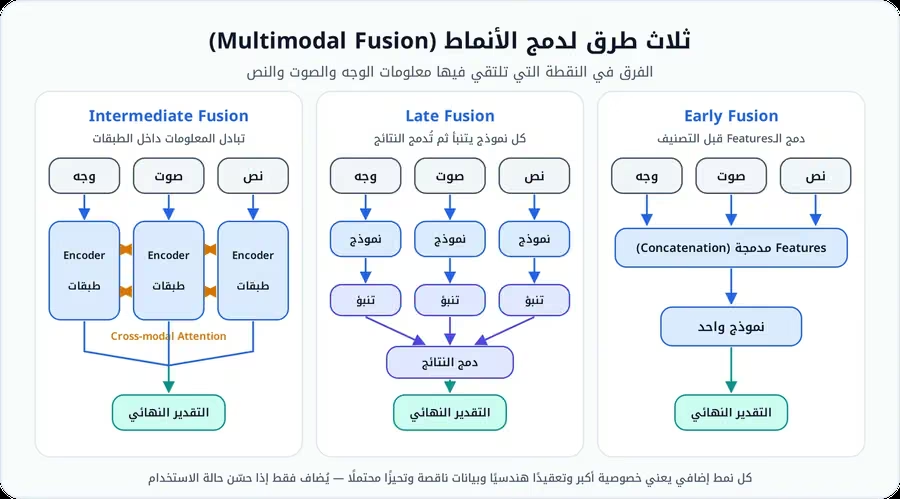
Other channels can be added to the face, such as voice, text, behavior, heart rate and its variability (HR/HRV), electrodermal activity (EDA), and wearable data. The idea is that the face alone is limited, and that additional sources may improve the representation in some tasks. Systems rely on three approaches to fuse these channels:
| Fusion Approach | Its Mechanism |
|---|---|
| Early Fusion | Merging features before classification |
| Late Fusion | Each model produces its prediction, then the results are merged |
| Intermediate / Cross-modal Fusion | Attention models and Transformers exchange information between modalities in internal layers |
But more data is not always better; every new channel means a greater privacy burden, higher engineering complexity, missing data, synchronization challenges, new bias, and additional processing cost. That is why a new modality should be added when it proves it improves the use case, not merely because Multimodal AI looks more advanced.
How Do We Design a Practical, Safer System?
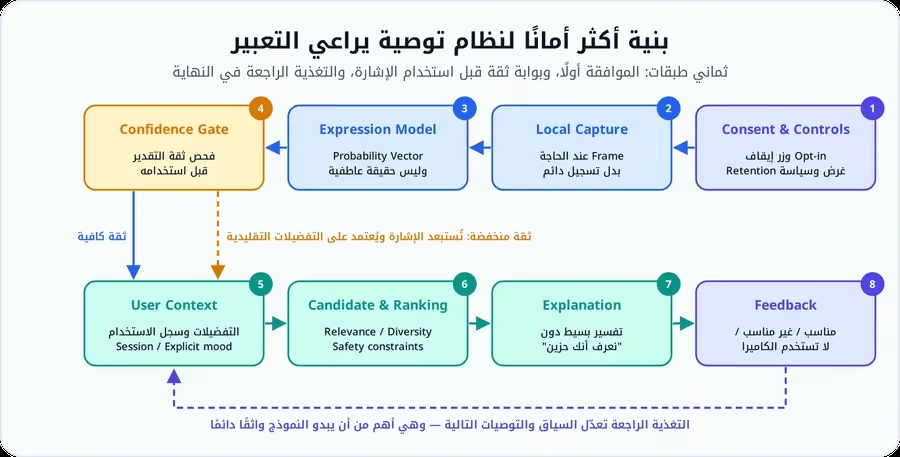
The architecture below gathers the preceding lessons into eight successive layers:
| Layer | Its Role |
|---|---|
| Consent & Controls | Before the camera runs: a clear explanation, opt-in, a stop button, a defined purpose, and a data retention policy |
| Local Capture | Capturing a frame when needed instead of continuous recording, unless continuous video is genuinely necessary |
| Expression Model | Producing a Probability Vector, not an "emotional truth" |
| Confidence Gate | If confidence is low: ignore the signal, ask for feedback, or fall back to traditional preferences |
| User Context | Merging preferences, history, session, explicit mood, and the estimated expression |
| Candidate Generation & Ranking | Ranking content by relevance, diversity, user preference, current context, and safety constraints |
| Explanation | A simple explanation such as "We suggested this list based on your preferences and the current recommendation mode," not "We know you are sad" |
| Feedback | Letting the user say: this fits, this does not fit, do not use the camera, or change my current mood |
That feedback in the final layer matters more than trying to make the model always look confident.
The Metrics That Must Be Evaluated
Face classification accuracy alone is not enough; the system must be evaluated at two levels:
| Level | Metrics |
|---|---|
| The expression model | Macro F1, per-class Recall, calibration, the confusion matrix, performance across demographic groups, performance across devices and lighting, and cross-dataset performance |
| The recommendation system | Precision@K, Recall@K, NDCG, click-through rate (CTR) where appropriate, skip rate, satisfaction, diversity, novelty, long-term retention with caution, and the rate at which users disable the Emotion Input feature |
And more important than all of these is a single question:
Is the system that uses the camera actually better than a baseline that does not?
If it does not deliver a clear improvement, adding the camera may not be justified.
The Question That Must Come Before Building
The question is not "How do we read the user's emotions with a camera?" but:
What decision do we want to improve, and what is the least sensitive data sufficient to improve it?
The answer may be click history, a manual mood choice, time, content type, or simple feedback. And if research proves that expression analysis adds independent value, it can then be introduced in an optional, restricted way.
Conclusion
Computer vision can analyze facial movement patterns and turn them into numerical estimates used as a signal within recommendation systems. But visible expression is not synonymous with inner emotional state, so a label such as "Happy" or "Sad" should not be the sole source of a personalization decision.
The most mature system is the one that preserves uncertainty, merges expression with context and other preferences, gives the user control, tests whether the signal actually improves recommendations, processes data locally where appropriate, audits for bias, does not use emotional state to exploit the user's vulnerabilities, and respects legal constraints, especially in education, work, and health.
This turns the idea from "a camera that knows how I feel" into "a system that sees limited signals, knows their limits, and uses them carefully to improve the content-selection experience." And that is the essential difference between an interesting technical demo and a responsible, usable product.
Sources and References
Rosalind W. Picard — Affective Computing, MIT Media Laboratory Technical Report
https://vismod.media.mit.edu/tech-reports/TR-321.pdfBarrett et al. (2019) — Emotional Expressions Reconsidered
https://journals.sagepub.com/doi/full/10.1177/1529100619832930Goel et al. (2024) — Face and context integration in emotion inference, Nature Communications
https://www.nature.com/articles/s41467-024-46670-5Goodfellow et al. (2013) — Challenges in Representation Learning / FER2013
https://arxiv.org/abs/1307.0414Lucey et al. (2010) — The Extended Cohn-Kanade Dataset (CK+)
https://www.pitt.edu/~jeffcohn/biblio/2010%20Lucey%20CK+.pdfMollahosseini, Hasani & Mahoor (2017) — AffectNet
https://arxiv.org/abs/1708.03985Li, Deng & Du (2017) — RAF-DB / Expression Recognition in the Wild
https://openaccess.thecvf.com/content_cvpr_2017/html/Li_Reliable_Crowdsourcing_and_CVPR_2017_paper.htmlPolignano et al. (2021) — Towards Emotion-aware Recommender Systems
https://doi.org/10.1016/j.eswa.2020.114382Zhang et al. (2024) — Deep learning-based multimodal emotion recognition: systematic review
https://doi.org/10.1016/j.eswa.2023.121692EU Artificial Intelligence Act — Regulation (EU) 2024/1689, consolidated 27 July 2026
https://eur-lex.europa.eu/eli/reg/2024/1689/2026-07-27/eng
Frequently Asked Questions
Can a user's feelings be known from the camera alone?
The model can analyze and classify or estimate facial expressions and movements, but they should not be treated as a definitive reading of the inner emotional state; context, culture, and individual differences shape the meaning.
What is the difference between facial recognition and facial expression recognition?
Facial recognition tries to identify the person's identity, while facial expression recognition analyzes patterns of movement and expression in the face. The latter does not necessarily need to know who the user is.
Must video be sent to the server?
Not necessarily. In some applications inference can run on the device and only limited results are sent instead of raw video, which reduces some privacy risks.
Can "sadness" be automatically matched with happy content?
It is technically possible, but it is not ideal design. Users differ in whether they want content that matches their state or changes it, so explicit preferences and feedback should be built in.
What is the best dataset for facial expression analysis?
No single dataset is "best" for every project. FER2013 is common, CK+ is lab-based, and AffectNet and RAF-DB are closer to real-world images. The choice depends on the environment the system will operate in.
Is using a camera in a recommendation system legal?
It depends on the country, the purpose, and how data is processed. In the European Union there are strong restrictions, including a ban on inferring emotions from biometric data in workplaces and educational institutions, with narrow exceptions for medical or safety reasons.
Does adding emotion recognition always improve recommendation accuracy?
No. Studies have shown benefits in specific domains, but they must be compared against a real baseline. If results do not improve enough to justify the risks and cost, there is no need to use it.
What is the simpler alternative to a camera?
An optional mood selector, session data, explicit feedback, or in-app behavior can be used. Sometimes these signals are less sensitive and more transparent to the user.
What does it mean for a recommender system to be emotion-aware?
It is a system that analyzes facial expressions via the camera and turns them into probabilistic estimates — a score per expression category — then uses them as an additional contextual signal to personalize content. It does not mean it knows true inner feelings; the estimate is combined with usage history, preferences, and current context, so the emotion signal is one feature inside the model, not the sole decision-maker.
How does a face image become a ranking of suggested content?
The pipeline has stages: capture the image, detect the face with models such as RetinaFace or MTCNN, align it using facial landmarks, then a CNN produces a probability distribution over expressions. A context layer then adds the user's history and preferences, candidate items are generated and ranked by a multi-factor score, and the system learns from feedback such as clicks, skips, and watch time.
Technical Discussion (0)
Sign in to join the discussion, reply and like comments.


