



Facial Expression Recognition (FER) is a computer vision task that aims to analyze the movements and patterns visible on the face and convert them into a digital representation the system can classify or estimate.
But one fundamental distinction has to come before any explanation:
Recognizing a facial expression is not the same as directly reading inner emotions.
The system may see the corners of the mouth rising, the muscles around the eye tightening, the eyes widening, the eyebrows lowering, or the mouth opening, and then link these movements to a category, a probability, or an emotional dimension. But it has no direct access to the person's intention, their inner experience, the full social context, their culture, or the reason for the expression.
That is why it is more accurate, in engineering terms, to describe the system as a graduated chain: the camera captures a visible facial movement, computer vision software analyzes that movement and extracts from it a representation of the expression, and finally the system issues a probabilistic estimate of an affective category or dimension. At every link in this chain, approximate inference accumulates, and at no point is there a direct measurement of the "true emotion"; that is not a technical output the system can produce, but an interpretive construct that lies outside the limits of what the camera measures in the first place.
Three Tasks That Start from the Same Face Image
The three tasks below all start from an image of a face, but they differ fundamentally in their question and output.
Face Detection
Its question is "Where is the face in the image?", and its output is usually a bounding box, and perhaps initial facial points. In practice, the image goes into the model and out come coordinates saying a face was found between the points (x1, y1) and (x2, y2). This output alone says nothing about the face owner's identity or state; its only job is to answer "where" precisely enough to trigger the next stages.
Face Recognition
Its question is "Who is this person?", and it takes two forms: Verification, meaning is this person the owner of the claimed identity? And Identification, meaning which person in the database matches this face? It is therefore a biometric identity task.
One example is our face recognition access control project, which matches the face in front of the camera against reference images of authorized people to tell them apart from unknown faces — a completely different task from reading the face's expression. While building that system we noticed that face capture quality depends on image clarity, lighting and camera angle, so we took the camera's position and field of view into account in the prototype — the very same factors that make reading expressions even harder.
Facial Expression Recognition (FER)
Its question is "What expressive pattern appears on the face?", and its output might be a distribution such as: neutral at 0.44, happy at 0.31, surprise at 0.12, sad at 0.07, and other at 0.06.
| Task | Question |
|---|---|
| Face Detection | Where is the face? |
| Face Recognition | Who is the person? |
| FER | What expression or facial pattern is visible? |
Confusing these tasks leads to flawed designs and incorrect evaluations.
Is FER the Same as Emotion Recognition?
Not quite. Facial Expression Recognition deals with the visual signal coming from the face, whereas Emotion Recognition is a broader concept that may try to estimate an emotional state from the face, voice, text, and body posture, from physiological signals such as ECG, HRV, and EDA/GSR, and from context. The face is just one channel among several.
This difference matters because modern psychological research warns against assuming a single fixed relationship between a specific facial movement and a specific inner feeling. A broad scientific review published in 2019 concluded that there are three main problems in inferring emotions from facial movements alone: limited reliability, the absence of a one-to-one mapping between movement and emotion category, and the influence of context and culture on expression and interpretation. An FER system is therefore responsible, in engineering terms, for analyzing a visible expression, not for claiming that it "knows what a person feels."
FACS: A Language for Describing Facial Movement
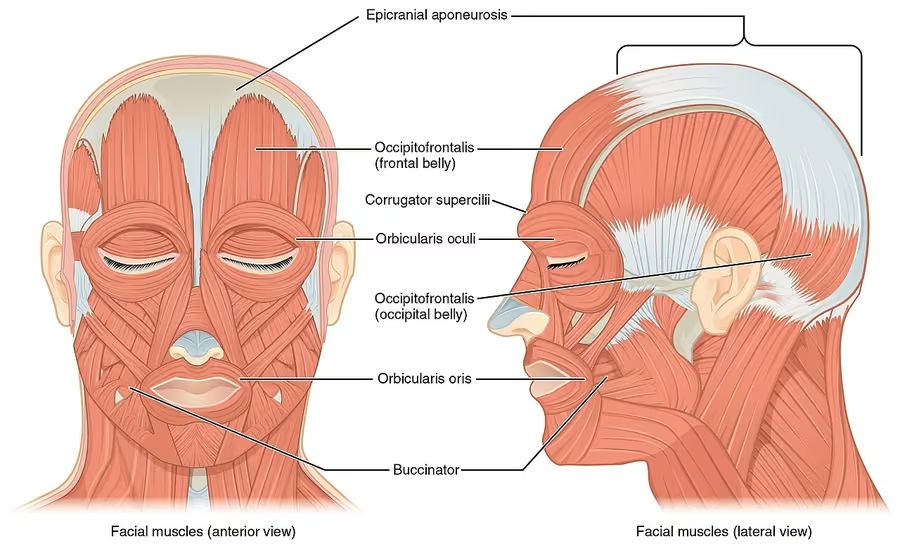
The Facial Action Coding System — FACS is a system for describing facial movements in a codable way. Its core idea is that instead of writing "this person is angry," we describe what actually happens on the face: the brow lowering, the cheek raising, the eyelid tightening, the lip corner rising, or the jaw opening. These elements are called Action Units — AUs.
Examples of Action Units
| Unit | Movement |
|---|---|
| AU1 | Inner Brow Raiser |
| AU2 | Outer Brow Raiser |
| AU4 | Brow Lowerer |
| AU6 | Cheek Raiser |
| AU12 | Lip Corner Puller |
| AU25 | Lips Part |
| AU26 | Jaw Drop |
The advantage of FACS is that it describes visible movement, which is scientifically more accurate than equating each Action Unit with a fixed inner feeling.
Does AU12 Mean "Happiness"?
Not that simply. AU12 describes the movement of raising the mouth corners, and it may appear in a social smile, joy, politeness, sarcasm, or a posed moment in front of the camera. Therefore:
Action Unit = a detectable facial movement, not direct proof of an inner feeling.
Three Ways to Represent Facial Expressions
An FER system can be designed with more than one kind of output, each with its own logic.
Categorical Expression Classification
The common categories in many datasets are Happiness, Sadness, Anger, Fear, Disgust, Surprise, and Neutral, with Contempt sometimes added. The output is a probability for each category: P(happy), P(sad), P(anger), and so on.
Action Unit Detection
Instead of choosing an emotion class, the system predicts whether Action Units are present or absent, for example AU4 active, AU6 inactive, and AU12 active. The task is usually multi-label, because several units may appear at the same time.
Valence and Arousal
Instead of discrete categories, the state can be represented in a continuous space: Valence runs roughly from negative to positive, and Arousal from low activation to high activation. This suits cases where we do not want to force every expression into a single rigid category.
From Camera to Result: The FER Processing Pipeline
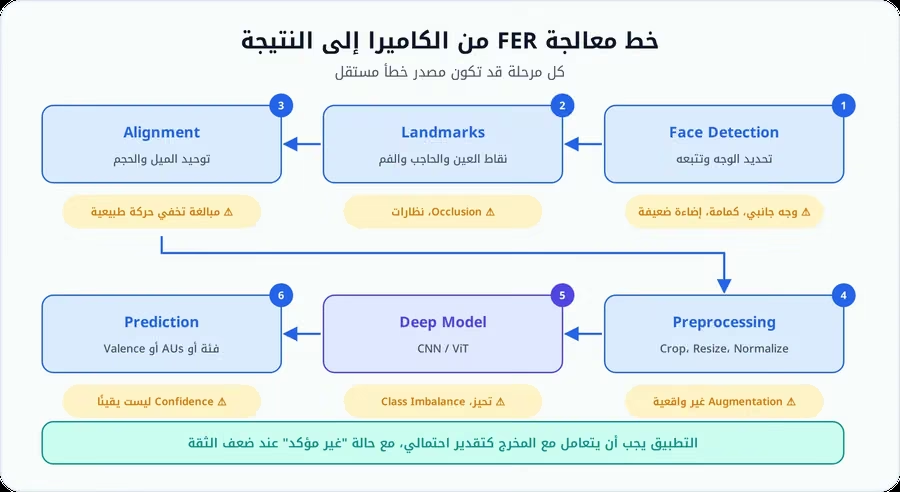
The pipeline starts with a frame coming from the camera, which goes through face detection to locate the faces in the scene, then face tracking, which preserves each face's identity across consecutive frames and prevents measurements from breaking up between one frame and the next. Next comes landmark extraction on the facial features, on which alignment is built to standardize the head's pose and angle, followed by cropping and normalization to produce a standardized face image ready for analysis.
That image then enters the feature extraction stage through a deep learning model that produces an internal representation, on the basis of which the system issues a prediction of the expression or of AUs, accompanied by a confidence or uncertainty score reflecting how reliable the decision is. These scores are not a luxury; the end application needs them to decide when to trust the result and when to fall back on backup behavior, because every stage in the chain, from detection to prediction, can be an independent source of error that accumulates in the final result.
Face Detection
The first step is locating the face. If the image contains more than one person, a cluttered background, a side-facing face, a mask, or poor lighting, a failure of the face detector means the rest of the pipeline may never start. Modern systems use deep learning models to detect faces, rather than relying solely on classic methods such as Viola-Jones.
Facial Landmarks
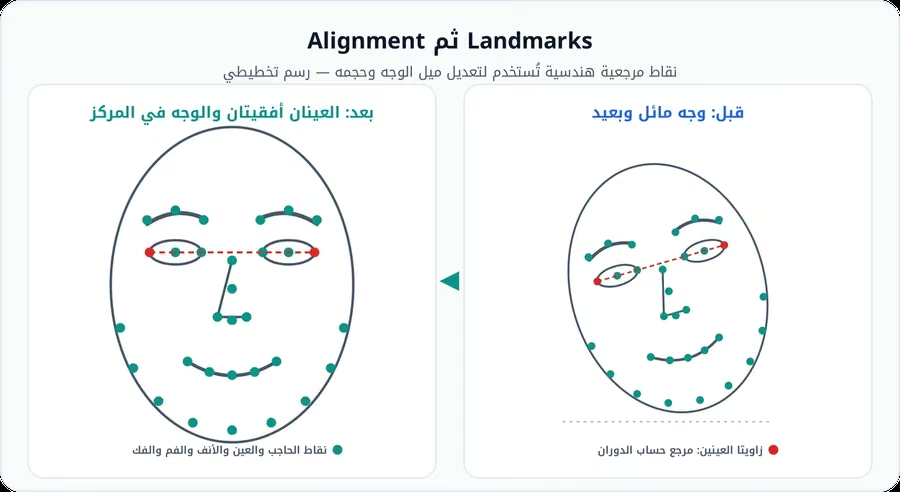
After detecting the face, reference points can be estimated, such as the eye corners, eyebrows, nose, mouth corners, and jaw, recording for example the coordinates of the left eye corner, the right eye corner, and both ends of the mouth. These points are used for alignment, computing distances, estimating head pose, extracting geometric features, and tracking motion across video. But landmark coordinates alone do not represent "emotions"; they are merely geometric measurements.
Face Alignment
If the face is tilted, distant, or rotated, comparing features becomes harder. Alignment tries to standardize the face's position using the reference points: making the eye line horizontal, centering the face, and normalizing its scale. This reduces variance unrelated to the expression itself. But excessive alignment can hide some natural movement, so the pipeline must be tested on real data.
Preprocessing
Preprocessing may include cropping, resizing, color normalization, contrast adjustment, and data normalization. During training, data augmentation can be used, such as horizontal flips, slight rotation, cropping, brightness changes, and occlusion simulation. But these transformations must be plausible; if augmentation makes the face unrealistic, the model may learn data that does not represent the operating environment.
From Handcrafted Features to Deep Learning
How Did FER Work Before Deep Learning?
Traditional methods relied on extracting features manually, in two main families: geometric features, such as the distance between the eyebrows, mouth width, mouth opening height, eyebrow angle, and eye-opening ratio; and appearance features, such as LBP, Gabor filters, and HOG.
These features are gathered into a vector that feeds a traditional classifier, such as an SVM, KNN, or Random Forest, which learns to draw the boundaries between expression categories in feature space, outputting the category closest to the new example. This approach can be lightweight, relatively interpretable, and suited to constrained environments, but it pays the price of relying on manual feature engineering: greater sensitivity to unexpected variation, and difficulty representing complex patterns the feature designer did not anticipate.
How Did CNNs Change Facial Expression Recognition?
CNNs learn visual features directly from images. The simplified deep approach goes through four stages: an aligned face enters a convolutional backbone that extracts, layer after layer, features ranging from raw to abstract; these gather into a rich visual representation that feeds a classification head, which turns it into expression probabilities. The essential difference is that the network learns these representations from the data itself, instead of an engineer manually defining a rule such as "measure the distance between the mouth corners," and so it captures patterns more complex and subtle than handcrafted rules can express.
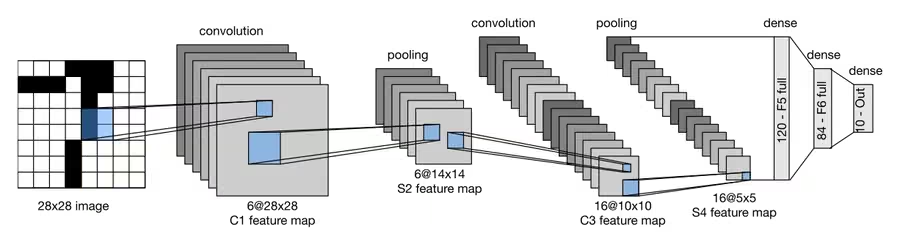
But that does not mean it learns "the emotions themselves," only patterns associated with the labels in the dataset. If the labels are noisy, biased, posed, or culturally narrow, the model will learn those limitations too.
Beyond CNNs
CNNs are not the only modern architecture; modern FER may use convolutional backbones, ResNet, EfficientNet-like architectures, attention mechanisms, Vision Transformers, temporal models for video, and hybrid CNN-Transformer models. Recent research focuses especially on robustness to head pose, occlusion, class imbalance, lightweight deployment, and temporal dynamics. But architecture is not the only problem, and data quality and label definition often matter more than swapping the backbone.
The Temporal Dimension: Is a Still Image Enough?
Expression Is Movement in Time
A still image is sometimes enough, but video provides additional information, because a facial expression is a temporal movement. A single expression evolves through distinguishable phases: the face starts from a neutral state, then comes the Onset phase as the muscles gradually contract, reaching the Apex when the expression is complete, and finally the Offset phase as the face returns to its previous position.
A still image sees one frame of this journey, and may land on an ambiguous moment that reveals none of it. Video, by contrast, captures the speed, direction, development, duration, and micro-dynamics of the movement, temporal signals that may help distinguish a spontaneous fleeting expression from a posed, sustained one. That is why tools such as 3D CNNs, historically RNNs/LSTMs, temporal convolution, Video Transformers, optical flow, and landmark trajectories are used with video.
Still Image or Video?
| Aspect | Still image | Video |
|---|---|---|
| Data | A single Frame | A Sequence |
| Cost | Lower | Higher |
| Temporal dynamics | No | Yes |
| Tracking | Often not required | Important |
| Latency | Simpler | More complex |
| Micro-movements | Limited | Relatively better |
| Privacy | Smaller volume | Higher sensitivity |
If the application needs only the momentary expression, an image may suffice; if it needs how the expression changes over time, video is technically better, but at higher cost and risk.
The Most Important FER Datasets
FER2013
It emerged from the ICML 2013 challenges and contains 35,887 grayscale images at 48×48 across seven expression categories. Its common split is 28,709 images for training, 3,589 for validation or the public test, and 3,589 for the private test. Its advantages are that it is easy for testing and teaching and widely used, but its limitations are clear: low image resolution, noisy labels, uncontrolled web images, and incomplete coverage of real-world scenarios.
CK+
Extended Cohn-Kanade — CK+ is a classic laboratory dataset containing 593 sequences from 123 participants, moving from neutral to peak expression, of which 327 sequences carry an emotion label from the defined categories. It is important for understanding dynamic facial expression, but it is not a perfect mirror of the real world, because many of its expressions are posed or directed, in front of a controlled camera, with easier lighting and pose than a real environment. This is a crucial point when comparing accuracy figures.
AffectNet
AffectNet was designed to represent expressions "in the wild." Its original version collected more than one million face images from the internet using emotion-related search terms in several languages, and a large portion were manually annotated. It supports two types of labels, categorical expressions and Valence/Arousal, an important advantage because it does not confine every expression to a separate class. But internet images themselves carry selection bias, cultural bias, label uncertainty, and class imbalance.
RAF-DB
The Real-world Affective Faces Database contains 29,672 real-world face images with basic and compound labels, each image rated several times through crowdsourcing. RAF-DB reveals an important problem:
Real-world expressions are more varied and complex than typical laboratory expressions.
The original paper noted that the Action Units associated with categories in real-world data are more varied than in laboratory datasets.
A Simplified Comparison
| Dataset | Size | Setting | Strength | Limitation |
|---|---|---|---|---|
| FER2013 | 35,887 images | Web / 48×48 | A common Benchmark | Low resolution and noisy Labels |
| CK+ | 593 sequences / 123 people | Laboratory | Dynamic onset→apex | Posed and controlled |
| AffectNet | >1M collected | In-the-wild | Large scale + Valence/Arousal | Imbalance / label uncertainty |
| RAF-DB | 29,672 images | In-the-wild | Crowdsourced + compound expressions | Does not eliminate distribution bias |
Comparing accuracy across datasets is not valid without understanding differences in categories, splits, image counts, label quality, setting, and evaluation protocol.
From the Lab to Reality
Why Do Models Shine in the Lab and Then Fail in Reality?
The reason is Domain Shift. A model may train on frontal faces, good lighting, strong expressions, and clean backgrounds, then be used on a mobile phone, at a 40-degree angle, in night lighting, with glasses, a beard, or a mask, and in front of a subtle expression. The model simply has never faced the same distribution before.
The Main Real-World Challenges of FER
| Challenge | What Happens |
|---|---|
| Head Pose | Parts of the face disappear, distances change with perspective, and landmarks shift |
| Occlusion | A mask, hand, hair, sunglasses, a microphone, or a VR headset covers parts of the face |
| Lighting | Light changes texture, shadows, and contrast, and can make wrinkles and subtle movements more or less visible |
| Subtle Expressions | An expression may be faint, fast, partial, or contradictory, not a "big smile" or "obvious anger" |
| Class Imbalance | Happiness is easier and more plentiful in some datasets, while disgust, fear, and contempt are scarcer |
Research in 2024–2025 still treats occlusion as one of the core challenges, confirming that the problem is not "solved" merely by using deep learning. Class imbalance, meanwhile, may give a model good accuracy while it performs very poorly on minority classes.
Why Overall Accuracy Is Not Enough
Suppose a dataset with 7,000 Happy images, 5,000 Neutral, 300 Disgust, and 200 Fear. A model that succeeds on Happy and Neutral and fails on Fear may still keep an overall accuracy that looks good. That is why you must check per-class Recall, Macro F1, Balanced Accuracy, the confusion matrix, and performance by subgroup.
What Does Confidence Mean in FER?
A model may output 0.88 for happy, but this is not necessarily "an 88% probability that the person is happy inside"; it is a score within a specific model and label distribution. The more accurate phrasing: "The model gives the happy category the highest score based on the facial pattern, according to its training."
In sensitive applications, calibration, uncertainty, and abstention must also be considered; if confidence falls below a defined threshold, the system declares the result "uncertain" instead of being forced into a decision.
The Limits of Inference: From Facial Movement to Feeling
Can Inner Emotions Be Inferred Accurately from the Face?
This is the most important point in the entire article. Facial movement carries information, but the relationship between Facial Movement and Internal Emotional State is not a fixed, universal, one-to-one mapping. The broad scientific review published in Psychological Science in the Public Interest in 2019 indicates that there is not enough reliability to make each emotional state always appear with the same movement, nor enough specificity to make each facial configuration belong to a single feeling, and that context and culture influence expression and interpretation.
A smile, for example, may mean joy, nervousness, politeness, embarrassment, sarcasm, or an attempt to hide another feeling. That is why language such as "Facial expression estimate," "expression-related signal," and "probabilistic affective inference" should be used, while phrases such as "AI knows how you feel," "camera reads emotions," and "detects the true emotion" should be avoided.
FACS Is Not an Emotion Detector Either
FACS does not say that AU6 combined with AU12 means the person is happy inside; it merely describes facial activity.
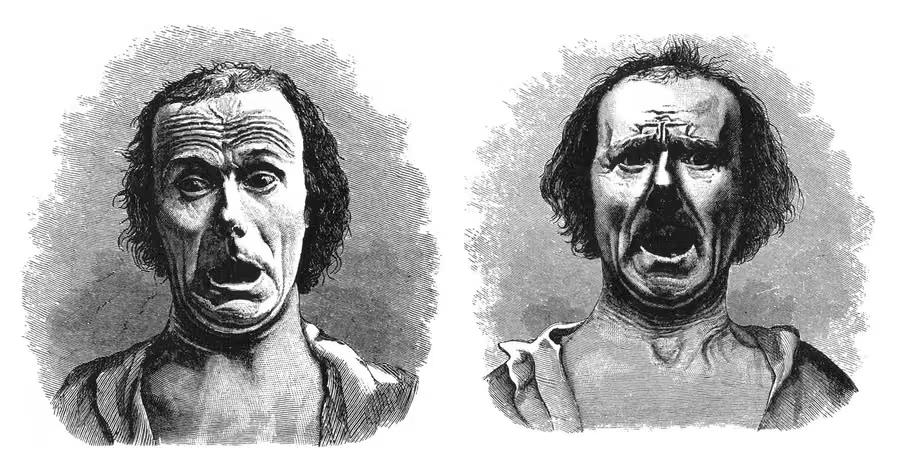
A system engineer can build a mapping to particular classes on top of these units, but that becomes a Model assumption that needs validation. This is a key point for separating measurement from interpretation.
The Role of Context
Look at a single facial expression without context, and it may seem ambiguous. Then add the person's voice, the sentence they said, the event, the interaction, their body posture, and their culture, and your interpretation may change entirely. That is why affective computing is moving toward Multimodal systems, though a multimodal system itself does not reach an "inner truth" directly; it simply has more signals.
The Facial Expression Model Versus the Multimodal Affect Model
A facial expression model takes the face image alone and outputs expression probabilities: a single input channel and a single, limited output. A multimodal affect model covers much wider ground: the facial expression from the camera, the tone and features of the voice, the content of the spoken text, physiological signals such as heart rate and skin conductance, and the usage context that interprets the same face differently in different situations. These channels are combined in a multimodal Fusion stage, producing a probabilistic estimate of affective state deeper than any single channel can reach.
This multiplicity gives the system greater robustness when one channel weakens and another compensates, but it multiplies the burdens of privacy, complexity, data synchronization across channels, handling missing modalities, and obtaining consent.
Are the "Six Basic Emotions" a Final Truth?
They are a highly influential framework in research, teaching, and datasets, but treating them as six fixed, universal states, each with a specific face, is an oversimplification. Categorical models are practically useful, but there are also dimensional approaches (Valence/Arousal), Action Unit approaches, appraisal and contextual approaches, and compound expressions. Choosing labels is therefore a modeling decision, not a direct discovery of six separate biological states.
Demographic Bias
If the dataset does not represent the actual population, performance may vary between groups. Sources of bias include age distribution, skin tone, sex, culture, camera quality, the label collection method, and the difference between posed and spontaneous expressions. Testing overall accuracy is not enough; where needed, performance must be measured by subgroup, while making sure that this analysis is itself legal and ethical.
Privacy and the Law
Highly Sensitive Data, Even Without Identity
Camera-based FER may handle highly sensitive information. Even if the system does not store the user's identity, it may process the raw face image, landmarks, embeddings, expression probabilities, timestamps, and a behavioral profile, data that could allow a profile of the user to be built.
Privacy by Design for an FER System
The first principle is local processing: when the device's capabilities allow, it is preferable for the FER pipeline to process the camera frame on the device itself and output only the expression vector, instead of uploading raw video to the cloud. The difference is not merely implementational but ethical and engineering-related too: on the local path, the face image never leaves the user's device at all, and the leakable data is confined to an abstract vector of numbers from which the face cannot be reconstructed.
The second principle is not storing video unnecessarily: if the task needs only a momentary result, the frame is processed, the result extracted, and the raw image deleted. The third is Data Minimization: audio, location, or identity are not collected unless necessary for the task. The fourth is Purpose Limitation: if the user agreed to improving the app's interface, the data should not later be turned into psychological advertising profiles without a clear basis and appropriate consent or legal basis. The fifth is transparency about what the system infers: the user must not believe that "the camera is just on" while the system is analyzing their facial expressions.
What Does the European AI Act Say?
The European Union's AI regulation places direct restrictions on some uses of Emotion Recognition:
Article 5 prohibits the use of AI systems to infer people's emotions in workplaces and educational institutions, except for uses put in place for medical or safety reasons.
This is critically important for any FER system marketed as measuring employees' emotions, monitoring students' focus, or inferring a learner's psychological state; in the EU, such applications cannot be treated as ordinary use cases. Laws in other countries may differ, so a legal review by market is required.
Is the Face Always Biometric Data?
A facial image may become biometric data when it is technically processed for purposes that allow or confirm the unique identification of a person, according to the legal context. FER may not need identity at all, but that does not make face data "non-sensitive." There is a difference between the question "Who are you?" and the question "What facial pattern are you displaying?", but both need a clear privacy design.
Is FER Suitable for Mental Health?
Great caution is needed here; facial expression alone is not enough to diagnose depression, anxiety, PTSD, suicide risk, or any mental disorder. It may be a signal within research or a larger clinical system if it is validated, regulated where required, and supervised by qualified professionals. But a face classifier should not be turned into a "psychological diagnosis."
How Do You Build a More Responsible FER System?
Step 1: Define the Right Output
Instead of writing "Detect emotion" in the project requirements, write "Estimate visible facial-expression category" or "Detect selected Action Units." This wording forces the team to specify what it actually measures.
Step 2: Define the Use Case
Is the goal avatar animation, accessibility, human–computer interaction research, content adaptation, driver monitoring, or medical research? The risks differ fundamentally from one case to another.
Step 3: Choose Labels Carefully
The best fit may be Action Units, Valence/Arousal, or expression classes, depending on the task.
Step 4: Collect a Representative Dataset
Test diversity in ages, skin tones, head poses, lighting, camera types, and occlusion.
Step 5: Split the Data by Person
A common mistake is having images of the same person in both training and test sets, so the model learns features tied to the person's identity instead of the expression. So use a subject-independent split in real evaluation.
Step 6: Test Across Different Datasets
Train on one dataset and test on another; this reveals weak generalization far better than testing within the same dataset.
Step 7: Do Not Rely on Accuracy Alone
Monitor Macro F1, per-class Recall, the confusion matrix, subgroup metrics, and calibration.
Step 8: Add an "Uncertain" State
The system does not have to classify every frame; alongside categories such as neutral and happy-like, its outputs can include two explicit states: uncertain and face not reliable.
Step 9: Separate Identity from Expression
If you do not need face recognition, do not build it.
Step 10: Minimize Data Retention
Especially raw frames, video, and identity-linked embeddings.
Landmarks or Deep Representation?
| Approach | Suits When |
|---|---|
| Landmark-based | We want geometry, relative interpretability, low compute, and motion and AU analysis |
| End-to-end Deep Model | Images are complex, data is available, and we need to learn texture and geometry implicitly |
| Hybrid | We combine RGB image features, landmarks, optical flow, and Action Units, which may excel in some scenarios |
No single approach wins in every case.
How Do You Test FER in the Real World?
The Test Matrix
Build a test matrix covering the factors you will face in actual operation:
| Factor | Cases |
|---|---|
| Light | Bright / low / backlit |
| Pose | Frontal / right / left / above / below |
| Occlusion | Glasses / mask / hand / hair |
| Camera | Phone / Webcam / CCTV |
| Distance | Near / medium / far |
| Expression | Strong / subtle / neutral |
| Motion | Still / Moving |
| Users | Diverse groups |
Then measure detection success, FER performance, latency, failure cases, and uncertainty.
What Do You Do When the System Fails?
Do not hide failure; design outputs that announce it explicitly: Face not detected, Face partially occluded, Low confidence, Unsupported pose, or No decision. All of these are better than a high-confidence but unreliable prediction.
The Future of FER
The field is not heading toward "a camera that reads minds," but along a more realistic technical path: models more robust to occlusion, head pose, and low light; lighter models that run on the device itself; temporal models that exploit dynamics instead of a single frame; and multimodal fusion combining face, voice, text, and physiology. It is also moving toward Action Units and continuous affect instead of relying solely on seven classes, toward uncertainty-aware systems that know when to abstain from a decision, and toward privacy-preserving processing done locally with less data.
The Relationship to Other Articles
This page specializes in a single question:
How does AI analyze facial expression technically?
Affective computing is broader, covering voice, text, physiological signals, and context. And an expression-based content personalization system builds a layer on top of FER: it takes the expression output and fuses it with the user's context in the recommendation engine, turning a momentary measurement into a personalization decision. That additional dimension alone is enough to make it a different system with its own risks and governance, which is why these topics remain separate pages rather than being merged into one massive article.
Conclusion
AI facial expression recognition is not a direct jump from camera to emotion, but an integrated engineering chain: it starts with the camera, then face detection, then landmark extraction and alignment, then building a visual representation inside a CNN, Transformer, or AU model, then expression probabilities, and finally the confidence scores and context that determine how the decision will actually be used.
The most important dividing line in all of this:
The face provides visible signals, and the model performs probabilistic inference; no technical channel reaches directly into a person's inner emotional experience.
That is why a good system is not measured only by its accuracy on a benchmark, but by clear answers to deeper questions: What exactly does it measure? Is its data representative? How does it cope with occlusion and head pose? Does its performance vary across users? Does it know when it is not confident? What happens to the raw images? And is the use case itself legally and ethically appropriate?
When FER is built this way, it becomes a useful tool for computer vision and human–machine interaction, rather than turning into an exaggerated claim that AI "reads emotions."
Sources and References
Lisa Feldman Barrett et al. — Emotional Expressions Reconsidered: Challenges to Inferring Emotion From Human Facial Movements
https://pubmed.ncbi.nlm.nih.gov/31313636/Goodfellow et al. — Challenges in Representation Learning: A report on three machine learning contests (FER2013)
https://arxiv.org/abs/1307.0414Lucey et al. — The Extended Cohn-Kanade Dataset (CK+)
https://ieeexplore.ieee.org/document/5543262Mollahosseini, Hasani, Mahoor — AffectNet: A Database for Facial Expression, Valence, and Arousal Computing in the Wild
https://arxiv.org/abs/1708.03985Li, Deng, Du — Reliable Crowdsourcing and Deep Locality-Preserving Learning for Expression Recognition in the Wild (RAF-DB)
https://openaccess.thecvf.com/content_cvpr_2017/html/Li_Reliable_Crowdsourcing_and_CVPR_2017_paper.htmlSariyanidi, Gunes, Cavallaro — Automatic Analysis of Facial Affect
https://doi.org/10.1109/TPAMI.2014.2330597Wang et al. — Region Attention Networks for Pose and Occlusion Robust Facial Expression Recognition
https://arxiv.org/abs/1905.04075FERMixNet — Occlusion Robust Facial Expression Recognition, IEEE Transactions on Affective Computing
https://ieeexplore.ieee.org/document/10663852/EU Artificial Intelligence Act — Regulation (EU) 2024/1689, Article 5
https://eur-lex.europa.eu/eli/reg/2024/1689/2026-07-27/engPicard — Affective Computing
https://mitpress.mit.edu/9780262661157/affective-computing/
Official documentation & standards
Frequently Asked Questions
What is facial expression recognition?
It is the automated analysis of movements and visible patterns on the face to classify the expressed emotion, detect action units, or estimate dimensions such as valence/arousal.
Does FER read real feelings?
No. It can analyze facial signals and build a probabilistic estimate, but inner feeling is shaped by context, culture, and the person, and cannot be extracted directly from the face alone.
What is the difference between face recognition and FER?
Face recognition looks for the person's identity, while FER analyzes the expression pattern visible on the face.
What is FACS?
A system for coding facial movements into action units. It describes the visible movement and does not by itself prove a specific inner feeling.
What are action units?
Coding units for specific facial muscle movements, such as raising the corners of the mouth or lowering the brow.
What is FER2013?
A popular dataset for facial expression classification containing 35,887 grayscale 48×48 images across seven categories.
What is CK+?
A dataset containing 593 sequences from 123 participants, 327 of which carry emotion labels, usually showing a transition from neutral to a peak expression.
What is AffectNet?
A large dataset collected from the internet with over one million gathered images, manual annotations for a large portion of them, and support for categories and valence/arousal.
What is RAF-DB?
A dataset of 29,672 real-world images with labels collected from multiple annotators, covering basic and compound expressions.
Why isn't accuracy within CK+ enough?
Because CK+ is a relatively controlled lab environment, and performance can drop when moving to real-world cameras, lighting, faces, and angles.
Technical Discussion (0)
Sign in to join the discussion, reply and like comments.


